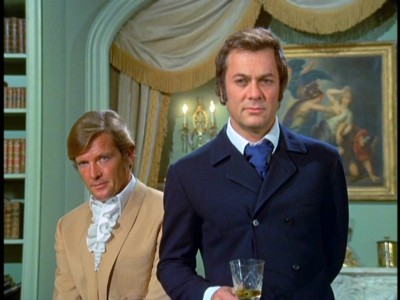
As the luxury-priced streets of London are gradually appropriated by the likes of Tesco Metro, it’s refreshing to find a gem of quirky individuality on a thoroughfare just off Piccadilly. The Jermyn Street Theatre once housed changing rooms for the staff of the Getti Restaurant (formerly the Spaghetti House).
In 1991, Howard Jameson had a vision to transform the space into an intimate studio theatre in the heart of the West End. The theatre opened in late 1994, thanks to a major donation from building firm, Laing – and further renovations were made in 1997, with the help of a National Lottery Grant from the Arts Council.
Prior to the first night of the theatre’s latest production - The Art of Concealment, a play about the life of Terence Rattigan - I met up with movers and shakers behind the show for a celebratory drink at Getti (see above).

Producer, Alexander Marshall, showed me his Sgt. Pepper’s Lonely Hearts Club tie.

And, as curiously cumbersome juggernauts manoeuvred awkwardly in the narrow street outside, writer Giles Cole told me about his new play.
Cole’s tribute to the legendary playwright is based on material gleaned during his editing work for Rattigan’s official biographer, Geoffrey Wansell. The plot cleverly weaves together episodes from Rattigan’s early (1920s and ‘30s) and later (1950s to ‘70s) life, to tell a story encompassing homosexuality, deception, torturous familial relationships, ageing, love and loss.
The casting is strong, with Judy Buxton and Graham Pountney impressively taking on double roles. Alistair Findlay makes a very convincing Older Terry, as does Charlie Holloway, as his lover - and Christopher Morgan as Cuthbert. But it’s Dominic Tighe, as the younger Terry, who steals the show, with a commanding swagger of narcissistic bravado that hides inner torment. Tighe’s sonorous voice is worth the visit alone, and his mastery of the play’s most poignant moments makes for a laudable performance.
An after-party, held at the Garrick Club, was a suitably splendid affair.
Inspired by the art of concealment, I whipped out my carefully hidden camera to take a few snaps of the grandiose surroundings and mind-blowing art collection for readers of the ShopCurious blog. I hope that’s not going to cause any embarrassment…
Do you?
Twitter Updates
Followers
About Me
- Susan
- Curiously crazy? Curiously creative? Curiously clever? A colourful curiosity? Are you curious?
My Blog List
-
dropshipper4 years ago
-
-
I'm back!11 years ago
-
New Word : ICONATOMY14 years ago
-
Total Pageviews
Links
- BLDG BLOG
- Cabinet of Wonders
- Colin McDowell
- disneyrollergirl
- Elizabeth Avedon
- Fashion Preserve
- fredbutlerstyle
- Godammit, I'm Mad!
- Lenorenevermore
- Luxe et Vanites
- Make Do Style
- Morbid Anatomy
- Nigeness
- Outsapop Trashion
- Pretty Portobello
- Profoundly Superficial
- Race Of Style
- Random Fashion Coolness
- ruminant
- Simply Healing
- Stella's Roar
- Style Bubble
- Style Porn
- The Spectator Arts Blog
- Think of England
- Thought Experiments
Tag Cloud
Style with brains.
Friday, 13 January 2012
The Art of Concealment
Wednesday, 5 October 2011
Memories, magic and bountiful blessings

I could easily have spent a whole day at the Wellcome Collection. The latest show, Miracles & Charms, which starts tomorrow and runs until 26th February 2012, is actually two exhibitions. The trailer video gives a taster, but is no match for the miracles and charms you will encounter:

The rooms are packed from floor to ceiling with saviours, protectors, mascots, amulets - and about as much good luck as you could ever wish for. One part is dedicated to Infinitas Gracias: Mexican miracle paintings. There are over a hundred votive paintings, depicting around 300 years of answered prayers (see above, top). There’s also a contemporary votive wall (see above, right and below) from a church in Guanajuato, filled with everything from family photographs, drawings, love letters, and examination certificates to religious relics, wedding dresses, bouquets, and baby clothes. This part of the exhibition explores the culture and people behind the votive tradition.


The other part of the show features hundreds of lucky charms amassed by Bank of Scotland cashier and obsessive folklorist, Edward Lovett (1852-1933), who scoured the city by night, buying curious objects from London’s herbalists, mudlarks, barrowmen, and sailors. They eventually became part of Henry Wellcome’s collection, curated here by Felicity Powell, and displayed as a ‘river’ of artefacts in a horseshoe-shaped cabinet, alongside some of her own contemporary works.
Powell’s Charmed Life is “A please to the votives’ thank you” and considers the strange allure of small objects, invested with mysterious potency and meaning through superstition. Like this sovereign-sized disc of paper, on which is inscribed the Lord’s Prayer (though you’d need a magnifiying glass to read it), which was taken into battle by a World War I soldier.
Other curiosities include peony seeds (for sudden incapacity), sea horses (kept by the nursing wives of fishermen to facilitate the flow of milk to their breasts), mole feet (a cure for cramp), acorn amulets (a safeguard against lightning), coral (for “sympathy with blood”, or good health), and a parade of lucky shoes (symbolizing the path of life). If you’re looking for something similar, you may wish to visit ShopCurious.
Powell’s wax images, meticulously crafted onto mirror backs, are extraordinary and worth an exhibition in their own right. Watch her film, Sleight of Hand, based on the theme of concealment – or mediate to William Basinski’s ambient music, as nebulous concepts, like hope and anxiety, are given form...
I just hope this inspires you to go along. The clincher is that it’s free of charge – the only requirement is that you’re incurably curious…
Are you?
Tuesday, 1 March 2011
Local icons with universal identity?

Happy St David’s Day! My grandmother, who sadly died years ago, was born in Wales, so I decided to explore my Welsh heritage. Welsh icons include leeks and a delightfully archaic national costume. But it’s not all coal, rugby, sheep and dragons in this curiously Celtic corner of our little island... There are also daffodils and lovespoons too - the latter being rather pertinent in view of Prince William’s impending nuptials - what with him being based at RAF Valley in Anglesey and next in line to inherit the heir apparent's title, Prince of Wales.
Possibly dating from the 14th century, and based on the ‘cawl’ or soup spoon, lovespoons were carved by young Welshmen to demonstrate their practicality and craftsmanship (much needed in rural Wales) to the father of their intended brides. The suitor carved one or more of a selection of traditional symbols to convey his special message:
Single Heart – My Heart is yours
Double Heart – Love is returned, we feel the same way
Celtic Knot – Everlasting
A Flower – Courtship
A Daffodil – Flower of Wales
The Dragon – Symbol of Wales / Protection
A House – My Home is Yours
A key / Keyhole – My Home is Yours
A Chain – Captured Love
Balls in a cage – Captured Love / Number of Children Desired
Heart Shaped Bowl – Fulfilled Love
Double Bowl – The Couple
Triple Bowl – The Couple and family
Vines – Growing Together
Horse Shoe – Good Luck
Bells – The Wedding
A Cross – Faith
A Ship – Safe Journey through Life
An Anchor – I Want to Settle Down
(List courtesy of Lovespoons Wales).
However, accepting this token of love was by no means an indication that a Welsh girl would marry her suitor - and some popular women amassed huge collections of lovespoons…
Anyway, I blame the Royal Wedding for my digression onto the subject of lovespoons, when what I really wanted to talk about is identity. These days it’s rare for us to identify ourselves with one particular place and culture. Most of us are a conglomeration of influences, ranging from birthplace and hometown to cities we’ve travelled to and people we’ve met. Our unique psychogeography and the individual stories that make up our lives have become more significant than our local origins.
Unlike lovespoons, today’s gifts and tokens of affection are more likely to reflect globally procured character – like the curiosity charm necklaces by Cartography40N74W at ShopCurious.
But might this curious trend lead to the wholesale globalization of culture, and what will the implications be for future generations? Or has the nostalgia-led backlash already begun? Your comments are most welcome, especially if you’re proudly Welsh.
Are you?
Saturday, 22 January 2011
Bags of ancient bushido style...

This weekend we’ve got a distinctly Japanese flavour. I’m not sure if you’ve already seen the unusual handbags by British artisan designer Vivien Hew at ShopCurious? Viv’s latest ‘Bushido’ collection is inspired by the five moral codes of the Samurai Warriors.
“I was intrigued by the contradictions; the image of the ferocious head-carrying warrior in battle with the dignified, artistic, and spiritual, tea-drinking individual. I sought to separate the myth from the reality and to try to acquire some understanding of their conceptions of the world,” she explained to me.
Apparently the Samurai were habitual recyclers of armour; whether this was booty acquired on the battlefield, or heirlooms passed down from generation to generation. They frequently replaced the lacing of their armour to repair, update or personalise their battledress. Vivien also uses recycled materials wherever possible. Much of the leather in her products comes from recycled leather garments.
Personally, I love the funky Samurai tassels, however, probably the most unique thing about Vivien’s highly collectable bags is the woven fabric. Not only are the bags handmade, but the textiles and trims for every single one of them are also individually created by hand. Vivien says, “I drew on the vibrancy, the symmetry and order of the armour for my fabric designs. I used the vertical and horizontal stripes of the armour scales but made them less ordered and less predictable.”
I’ve noticed that all things Japanese are gaining ground over here too, from paper and origami in product design and art, to sculptural folding and pleating effects in fashion. I think we might be even see the rise of more curious fashion sub-cultures here too, like the gothic Lolita trend, featured in my post today at The Dabbler.
Do let me know what you think.
Will you?
Tuesday, 18 January 2011
Lost for words: A lassie's lament

Burns Night is celebrated in Scotland every year on or around January 25th. It commemorates the life of poet, Robert Burns, who was born on January 25th, 1759. The day also celebrates Burns' contribution to Scottish culture – his best known work is Auld Lang Syne.
I wouldn’t normally be mentioning this before the event, but this year I’ve been asked to do something very curious – especially so, as I’m what’s called a ‘sassenach’ – although one of my grandfathers did grow up in Scotland (not sure if that counts?)
Anyway, I’ve been asked to make a speech at a Burns Night Supper. Not just a speech, but a response to the Toast to the Lassies (which… typically, comes after the toast to the monarch, the toast to the haggis and the toast to great bard himself). Anyway, your guess is as good as mine as to what sort of thing I should say - and only one well known Scottish phrase comes to my mind: 'after dinner sit a while, after supper walk a mile.'
So if anyone has any helpful hints, or ideas - or has given one of these uniquely Scottish after dinner speeches before, I’d love to hear from you, as the clock is ticking away, and I’m still psyching myself up for the role.
Meantime, I’ve been finding comfort tracking down some curiously cute accessories to make sure my outfit for the evening is in keeping with the theme. If you’re looking for something curiously Celtic too, there’s a wonderful winter white, vintage rabbit foot brooch at ShopCurious. I’m certainly going to be wearing one of these, as they’re meant to be lucky... and I need all the help I can get - as does the haggis, apparently.
Once again, any ideas for the speech would be very much appreciated – but please feel free to leave other comments too.
Will you?
Saturday, 4 December 2010
Identifying the art in fashion

The GSK Contemporary exhibition at the Royal Academy – Aware: Art Fashion Identity, encourages us to think differently about fashion. I left with enough ideas to fill a book – though the accompanying catalogue does rather a good job of summarizing the metaphor and meaning behind the main exhibits.
The show runs until the 30th January 2011 and is divided into four sections. Storytelling considers the role of clothing as an expression of personal and cultural history; Building is about the concept of clothing as a form of protection – a sort of shelter from the changes taking place around us; Belonging and Confronting looks at notions of nationality and displacement – political, social and religious differences and the tensions associated with the assimilation of new cultures. And Performance highlights the importance of the roles we play in our daily lives.
Most of the pieces are by artists rather than fashion designers. The exhibits reflect a multitude of influences from globalization, cultural transformation and feminism to architecture, memories, class, environmental issues and rites of passage. And the show has as much to do with the study of psychogeography as it does the concept of identity.
This Alexander McQueen dress is from his 1998 collection, which was inspired by the story of Joan of Arc. The final scene featured a model wearing a beaded dress, encircled by flames.
Looking at it I was reminded that designers are very often the faceless front of fashion. They put huge emotional energy and incredibly long hours into producing collections that are presented in catwalk shows only a few minutes long, and have selling seasons that may last only a matter of weeks before products are marked down, or considered worthy of clearance.
To Andrea Zittel, clothes are very much functional objects. She rejects consumerism in favour of simplicity and sustainability by creating a few pieces of clothing every year, each to be worn for a several months. Her garments are handmade using traditional techniques and dyed with natural colouring, often employing old established methods to work in organic felt. In fact, this 1990s felt dress by Kazaski at ShopCurious is rather similar in style to Zittel’s eco-friendly tunic designs.
Anyway, there are contributions from thirty contemporary international artists, so there’s plenty more to look at and consider. And with a patisserie and cafĂ© run by sketch, there’s lots of food for thought too. Oh, and the show is likely to be a sell out, so don’t leave it too late to cast a critical eye.
Will you?
PS To identify yourself in a curiously arty way, check out today’s post over at the Dabbler.
Saturday, 9 October 2010
Umbrella dilemma: Do real men use umbrellas?

It’s been particularly wet in Britain recently, but I sincerely hope you don’t need to use an umbrella this weekend. If so, please shake it dry before you bring it into the house…
According to Victorian etiquette, a man ‘may leave his umbrella and cane in the hall, but not his hat and gloves.’ It would be terribly embarrassing to be considered ‘an unpleasant caller just in out of the rain, whose overcoat and umbrella drips on the carpet.’
In the past there were strict rules relating to the use of umbrellas – one learned how to furl an umbrella properly, to hold the handle in the right hand, to grip the ferrule in the left, with folds lying neatly one over the other – and so on…
It used to be traditional for every City gent to carry an umbrella. But all that changed only a couple of decades ago.
Of course, some would argue that no real man would ever use, or even be seen carrying an umbrella. The Duke of Wellington was astonished when in 1913 Bayonne, officers of the Guards put up their umbrellas because it was raining. But the guards loved their umbrellas and eventually a tightly furled umbrella became part of the guards’ town and civilian uniform.
Men who are reticent to carry umbrellas, often believe them to be for wimps. They’d rather get wet. Anyway, for those who are happy to be be seen with them, here are a few of the current options available (unfortunately not from ShopCurious) if you happen to be shopping for an umbrella..
First, there's the fold up version, as modelled here by Steve from Style Salvage. By the way, Fulton is one of the best known UK manufacturers of this variety (Mr Fulton is a charming old gentleman too). But would a gentleman dare to be seen with such an accessory?
For the classic, retro-style black City umbrella best go to Fox (inventors of the steel framed umbrella),
or Briggs for this type of design (though these can also be very pricey ) The bamboo handled whangee looks by far the most stylish design to me..
There’s also the over shoulder version – perfect for country pursuits, not so sure about Henley Royal Regatta…
Another is the popular corporate or golfing umbrella, often featuring a straight rather than bowed handle - along with the ubiquitous logo.
For night, there’s an electric, an LED umbrella – or even the suitably high-tech wi-fi Internet version?
Or perhaps you'd prefer something a little more arty or colourful?
So, do real men use umbrellas? I can't seem to find a picture of David Beckham carrying one... Does that mean they’re not cool? Let me know what you think on the subject of men's umbrellas. And what type of umbrella you prefer to carry, if any?
Will you?
PS Read more about the culture and philosophy of the umbrella over at The Dabbler today.
Saturday, 2 October 2010
Prince of retro filmstar style
I am and will continue to be a huge fan of Tony Curtis. I especially enjoyed watching him in cult 1970s series, The Persuaders. I can highly recommend his autobiography, American Prince, though was suprised this made only passing reference to his role as Danny Wilde.
The Persuaders is a showcase of '70s style, offering the utlimate in retro interiors, alongside fabulously cool and funky fashions. Above all, Tony Curtis seemed to be perfectly cast as the dashing and stylish American playboy, who'd worked his way from the slums of the Bronx to the international jetset.
What I loved most about Curtis was his individuality and flair. Apart from his obvious good looks and curiously charismatic manner, he had cultural and artistic interests that reached far beyond the film industry and Hollywood. His flamboyant personal style was a reflection of his larger than life personality, combined with his uniquely arty taste. Towards the end of his life he was usually pictured wearing a Stetson hat and one of his many cravats.
Amongst the old records I've got stored away is a 45 rpm recording of the original theme tune to The Persuaders by John Barry. I'd love to listen to this again, but am currently without a record player (as I've mentioned over at The Dabbler).
I'm afraid we don't have any for sale at the moment, either... but there's a rather special book about Hollywood stars, with some lovely old photos of Tony coming to ShopCurious very soon.
Keep a look out, or sign up for our monthly Curious Cognoscenti newsletter to be the first to hear of new arrivals to the website.
Friday, 24 September 2010
Anarchy at the design festival?
With funding raised from both private and public sources, Brody invites anyone so inclined to join him in expressing their creativity, by designing and/or making something in premises and with resources provided by ADF during the festival. He’s particularly concerned to get across the message that failure is okay. Design doesn’t have to be perfect. Designers should explore ideas, rather than being obsessed with style.
Brody wishes to encourage discussion... His own view is that “culture should be publicly funded.” He thinks that proposed cuts are purely “ideological” and that the Government is making a political statement. “Philosophically, the Government doesn’t want to fund culture,” he says.
With people travelling from all over the world to study design in the UK, London has become the international capital for interns, and the competition for jobs in design is high. The result is that Britain is now very much a global leader in the field of commercial and creative design, as evidenced from the world class output on display across the capital during the London Design Festival.
I’d never heard Mr Brody speak before, and whilst he was great at spinning out controversial sound bites, I remain unconvinced of his arguments. In my opinion, success needs to be measured in terms of something that’s useful to the designer, the end user and the person paying for the product. If that product is a work of art, then yes, there’s going to be more subjectivity involved in the purchasing process than if it’s purely functional. However, as we currently live in a capitalist society, and especially in the current economic environment, it just doesn’t make any sense to be paying for people to create stuff that’s not even any good – just so they can ‘experiment’.
Moreover, where does education fit in to all of this? It’s curious Brody thinks that competition and results aren’t important, especially in view of his new role at the RCA. Could it be that Mr Brody is trying to cash in on the new trend of DIY design? Or does he want to encourage a nation of spongers – or even incite us to anarchy, and a return to the Dark Ages?
Anyway, I think Tent London and the Origin Crafts Fair are showing some amazing pieces of work this year, made by an incredibly talented bunch of designers, who must be working very hard too. And these are just two venues out of around 200 events taking place as part of the original London Design Festival. If you’re ShopCurious, I suggest you take a look for yourself this weekend – and do let me know what you think.
Will you?
Wednesday, 15 September 2010
Style blitz hits Shoreditch

After it was decimated by bombs during the London Blitz, much of Shoreditch was rebuilt in soulless 1950s and ‘60s style. However, in recent years, the area has re-emerged as the inspirational new design hub of our capital. Artsy, vibrant and full of innovative young designer-makers, the area is enjoying its newfound status as the global centre of all things creative, cultural and cool.
With London Fashion Week almost upon us, and London Design Week (or London Design Festival as it now seems to be known) just ahead of that, this is the perfect location for a celebration of creativity at one of the most exclusive and stylish events of the Autumn/Winter season – The Shoreditch Ball.
On 15th October at Shoreditch Town Hall, local celebrities and the East End fashion cognoscenti will attend a night of culture, dancing and cabaret. A very special art, furniture and fashion auction is being hosted by Adrian Biddell of Sotheby’s, featuring work donated by local artists, fashion and furniture designers – reflective of the original creativity for which Shoreditch is renowned – and raising funds for local causes (Charity, TLC Care and local cultural hero, Chris McMuck). You can even bid for lots in the auction online, in advance. In view of the Pope’s impending visit to London, some of the items seem curiously appropriate.

The JAM Cross is a crucifix light, glowing pink and blue, inspired by the Las Vegas wedding chapel. Made in frosted Perspex and measuring 152cm x 92cm, this global symbol, drenched in meaning and iconography, is an exploration of religious taboos and fashion.

Pakistan based Alixandra Fazzina’s ‘Maternal Mortality’ is one of ten limited edition photographs of a startling image (reminiscent of the Madonna), conveying the perils of childbirth in Afghanistan.

However, if these themes are a little too heavy for you, the auction will be followed by some jazz- with singing by Natalie Williams, dance music from the twelve piece Ray Gelato Giants and DJ sets from none other than the East End’s resident fashion starlet, Pam Hogg.
So put on your sparkly tights, (I suggest the luxury edition Lourdes design from Bebaroque at ShopCurious) and let’s go out and party! I’m in favour of any opportunity to help promote the work of talented young designers and artists… as well as having fun for a good cause.
Are you?
Saturday, 28 August 2010
Designer books - a curious new fashion trend

We haven’t heard much from Mr McDowell lately – perhaps he’s away on holiday, or working on a new book. Colin McDowell’s thought provoking posts are a far cry from your average fashion blogger’s fantasy affairs, which I suppose is what comes from being one of the most knowlegeable and eloquent fashion journalists in the world.
Here’s a snippet from one of his more recent posts:
“It seemed natural after all that to set off up Fauborg Saint-HonorĂ© and hit the shops. My two male companions were in crazed must-have-it buying mood and egged each other on to buy … anything as long as it had a scary price tag, which meant everything, in fact. Respectively they bought a denim shirt and a pair of trainers (at a cost of over €700) and a pair of trainers and drop-crotch pants (close to €1000), all of which will be totally out of fashion in a very short time. Which is what being a fashion person is all about.”
Colin, I agree. It does seem that for many of us, ‘fashion’ has become a byword for overpriced designer label goods. What’s more, the strong pull factor of branded fashion in popular culture has got everyone trying to cash in on the latest faddish trends...Is brown the new black? Is short the new long? Are books the new trainers?
Come to think of it, astonishingly expensive designer books, a sudden demand for built-in libraries, ‘bibliotherapy’, book inspired artworks and home furnishings are just a few of the curious trends spotted by ShopCurious lately. I know we can't wear books, but expect to see book print fabrics, book inspired accessories and all manner of bibliomaniacal creations on the catwalk.
Oh, and over at The Dabbler, you can find out what us retro-progressive types make of stylized new additions to the book world.
Anyway, I guess it's all good news as it means we’ll be reading more... so I hope you’re feeling suitably bookish?
Are you?
Saturday, 14 August 2010
Dribbling along in retro-progressive style
Calling all Wags and fans of retro style with a curious new twist. In my new weekly blog over at The Dabbler, today's lead comes from cult early 1980s film, Gregory's Girl. If you're ShopCurious, you'll love the curiously quirky footballing fashions.
Are you?
Friday, 13 August 2010
Tink before you tattoo

Did you read the article from Shine, The 6 biggest tattoo regrets, that was posted on a major search engine’s lifestyle site today? There were a huge number of comments, indicating that an awful lot of people want to talk about their tattoo troubles.
If you’re looking to avoid regrets altogether, temporary tattoos can be the answer. At ShopCurious, we’ve just become the exclusive UK stockist of a new range of limited edition temporary tattoos by a company called Tink-It (Temporary Ink It).
None of your kiddy style sticker stuff here, the first Tink-It collection has been designed by achingly cool French artists, plus there are five designs to choose from, and between two and eighteen separate tattoos in each box set. Tinks last for one to three days and can be easily wiped off using make-up remover, but whilst they’re on your body, you’ll become a living work of art.
Tattoos are arguably the Marmite of the skin world, either loved or loathed. If you’re a fan of tattoos, are thinking of getting one, or simply curious to see how some people choose to express their personalties through body decoration, you might like to pop along to the ‘Skin’ exhibition at the Wellcome Collection, which runs until 26th September.
Part of the exhibition explores the skin “as a place where natural, cultural, artificial or supernatural marks inscribe themselves on the body. Human skin provides a living document of transformation, deformity, ageing and illness. It also serves as a canvas where personal and cultural practices of decoration, construction of identity and self-expression are communicated to the world." Something worth bearing in mind…
Tink about it.
Will you?