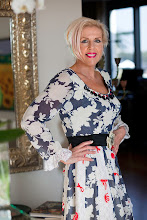
Little did the architects of the Big Biba store in London’s Kensington High Street know they were helping to create a legend. During its brief existence from 1973-75, the opulent emporium was hailed as ‘the most beautiful store in the world’.
Even Mr Al Fayed would have been impressed with the shop’s extravagant Art Deco interior, which was reminiscent of the glamorous, golden age of Hollywood.
Big Biba wasn’t just about style – it was the first lifestyle store. Here a young girl could “buy not only a new wardrobe, fully co-ordinated from head to toe, but also a complete range of cosmetics and soft furnishings, together with the washing powder to care for her clothes, and food to go with it, all presented in the distinctive Biba packaging.”
Alternatively, she could lounge around in the shop-windows (as Biba didn't have window-displays), or sip cocktails upstairs amongst the flamingos that lived in the Roof Garden, or in the Rainbow Room, where live music was performed.
'Biba style' was characterised by flowing lines, floppy hats and… pickled onions! For all it’s curiously cool, stylish charm – Biba was peculiarly quirky and eccentric: Even the food hall displays were in the shape of baked bean tins and Campbells soup cans. But it was the Biba logo that was immediately recognizable on the vast majority of the products.
Biba also produced a mail order catalogue, with girls wearing the complete Biba look – from clothing to makeup and accessories. The Biba look consisted of what Hulanicki called "Auntie colours" - which she said ‘look like a funeral.’ The predominant shades were blackish mulberries, blueberries, rusts and plums.


If you’d like to see more of images of the store and Biba’s designs, how about this fabulous, collectable coffee table book from ShopCurious. ‘Welcome to Big Biba’ features over 150 colour photographs from the seven storey department and is signed by designer, Barbara Hulanicki herself, as well as the book’s creators.
In addition to selling stylish fashion, Big Biba was a social network and curiosity shop all rolled into one. I have a feeling the legend will live on and on... I'm curious to experience Biba’s next incarnation – and see the website.
Are you?
Twitter Updates
Followers
About Me
- Susan
- Curiously crazy? Curiously creative? Curiously clever? A colourful curiosity? Are you curious?
My Blog List
-
dropshipper4 years ago
-
-
I'm back!11 years ago
-
New Word : ICONATOMY14 years ago
-
Total Pageviews
Links
- BLDG BLOG
- Cabinet of Wonders
- Colin McDowell
- disneyrollergirl
- Elizabeth Avedon
- Fashion Preserve
- fredbutlerstyle
- Godammit, I'm Mad!
- Lenorenevermore
- Luxe et Vanites
- Make Do Style
- Morbid Anatomy
- Nigeness
- Outsapop Trashion
- Pretty Portobello
- Profoundly Superficial
- Race Of Style
- Random Fashion Coolness
- ruminant
- Simply Healing
- Stella's Roar
- Style Bubble
- Style Porn
- The Spectator Arts Blog
- Think of England
- Thought Experiments
Tag Cloud
Style with brains.
Tuesday, 27 April 2010
Biba's everlasting appeal
Monday, 25 August 2008
Marco Polo's Silk Road

The Silk Road was a network of ancient caravan routes that opened commerce between the great civilisations of east and west. From the capital city of ancient China, Chang'an, the caravans crossed the deserts, mountains and steppes of Central Asia, all the way to the Mediterranean port cities of Byzantium (Constantinople) and Venice.
In addition to being a commercial trade route for silk and other curiosities, the Silk Route was also a means of spreading new ideas and religions as well as stimulating cultural and technological development.
The Silk Road reached its peak during the Monglian Empire in the 13th century, when China and central Asia were controlled by Mongol Khans. During the Middle Ages, the Venetians and Genoese controlled the bulk of Mediterranean trade, connected to the major trading centres of Constantinople, Antioch and Alexandria. The trading relationship between Europe and China was greatly strengthened by the voyages of Marco Polo.
Marco Polo was born to a wealthy, privileged family in Venice in 1254 and became one of the most famous merchants to travel the Silk Road. At the age of 17, he set out with his father and uncle for the court of Kublai Khan, returning 24 years later with many fantastical tales to tell of trips to places such as Ceylon, Cambodia, Thailand and Indonesia. He also reported on the incredible luxury and amazing wonders of the court of Kublia Khan, such as a palace built of marble and precious stones, a stable of 10,000 snow white horse, robes made entirely from gold thread and magicians who used spells to keep bad weather away.
On his return to Venice, Marco Polo was imprisoned during a war with Genoa, where he told fellow prisoner Rustichello of Pisa of his adventures in exotic lands. Rustichello published the stories in a book originally entitled Il Millione, but later named The Travels of Marco Polo. Later, as European powers developed their maritime fleets from the 15th century onwards, they put an end to the Arab control of the lucrative trade route and the ability of ships to transport commodities much faster and cheaper than camel trains resulted in the demise of the Silk Road by the 16th century.

We have a unique range of vintage silk scarf cushions at ShopCurious, some of which feature Venice - the 'Queen of the Adriatic' and major host to merchant ships of the Silk Route.
The cushions are beautifully handmade, each with an individual contrasting trim. These are great for the home in a fashion-meets-art-meets-furnishing sort of way and they also make a really unusual gift. Maybe you'll be inspired to invest in a piece of history?
Will you?
Thursday, 3 July 2008
New designers?
At part 1 of the New Designers exhibition in Islington's Business Design Centre yesterday, I was totally overwhelmed by the extraordinary wealth of talent displayed by young designers from around the UK. I was also stunned by the incredible array of stuff on show, from the huge selection of exquisite and professionally produced textiles to some rather primary school inspired ceramic pieces.
I was curious to spot the emergence of any design trends, but was hard pushed to find anything totally new. I did notice that some of the prints are more intricately patterned and that a paler colour palette/more floaty theme is in evidence, after last year's bolder and brighter look. Some of the woven textiles are utterly fabulous. In fact, there are so many wonderful fabrics, wallpaper and applied designs on display that they probably deserve a book rather than a blog - you'd better go and see them for yourself!
As for the rest of the exhibition - it's certainly an eclectic mix. There's a big 'handicrafts' type feel - think arts and crafts, William Morris and basket weaving. Here are some of the things I spotted:

The Middlesex stand (no reference to Lords cricket ground intended) featured some curiously colourful accessories, furnishings and art installations. The upholstery (see above) was very Designers Guild meets Roche Bobois, if you're into that sort of thing.

There was a Barbie-inspired wardrobe (left), the stuff of dreams if you're a six or seven year old girl ... and a rather rude-but-amusing tartan affair (right) which should be x-rated, so email ShopCurious with proof of your age if you want to see a larger-sized version.
I found the enormous jewellery offering rather uninspiring. I am in no doubt as to the exceptional quality and precision of workmanship in some of the fine jewellery pieces, but there was little that really stood out from the crowd. Some of the quirkier items included a couple of twisted metal trees (as shown), which 
the designer, Jennifer Millar, described as 'communal jewellery'. How long do you think they'd survive in your local park? And there was the delightfully suave and deliciously photogenic Patrick Mavros (pictured here) with his resin and gilded metal rings, necklaces and bracelets some of which light up at night... a bit like Star Trek's Eymorg control bracelet - beam me up Scottie.
Several people have used bits of plumbing equipment and taps to create weird and wonderful sculptures. Richard Tarek Doss from the Royal College of Art has incorporated oxygen cylinders into one of
his pieces (see above right and
right). Molly Harwood (left) uses cast glass and metal components to "represent vital organs within our body.... visual metaphors that aim to challenge emotions surrounding our inner workings and mortality."Could this be the start of a hot new trend, or is it just the outward manifestation of some bizarre fetish?

On to glass and ceramics, where again I felt I'd seen it all before - for instance this banana style chandelier (left), though I did quite like the familiar looking ceramic Madonna with child by Rebecca Kindred from Swansea (right).
Much more commercial, and fun too, is a range of plates (see right and below) printed with pictures of left over dinners - Britain's Dinners II by Damaris Booth - you can choose from Roast Dinners, Chinese, Curry, Fish and Chips, Pizza and Bangers and Mash. I do detect a whiff of patriotism creeping into some of the designs...

My verdict on part 1 of the New Designers exhibition - it's a veritable dog's dinner. If you've been along, or are planning to visit, I'm curious to hear your comments too.
Will you?


